The Capability Approach as a Normative Framework for Urban Biodiversity Management
Strong Points and Unresolved Issues
DOI:
https://doi.org/10.3384/de-ethica.2001-8819.269360Keywords:
urban biodiversity, the Capability Approach, social justice, animal ethics, plant ethics, ecocentrismAbstract
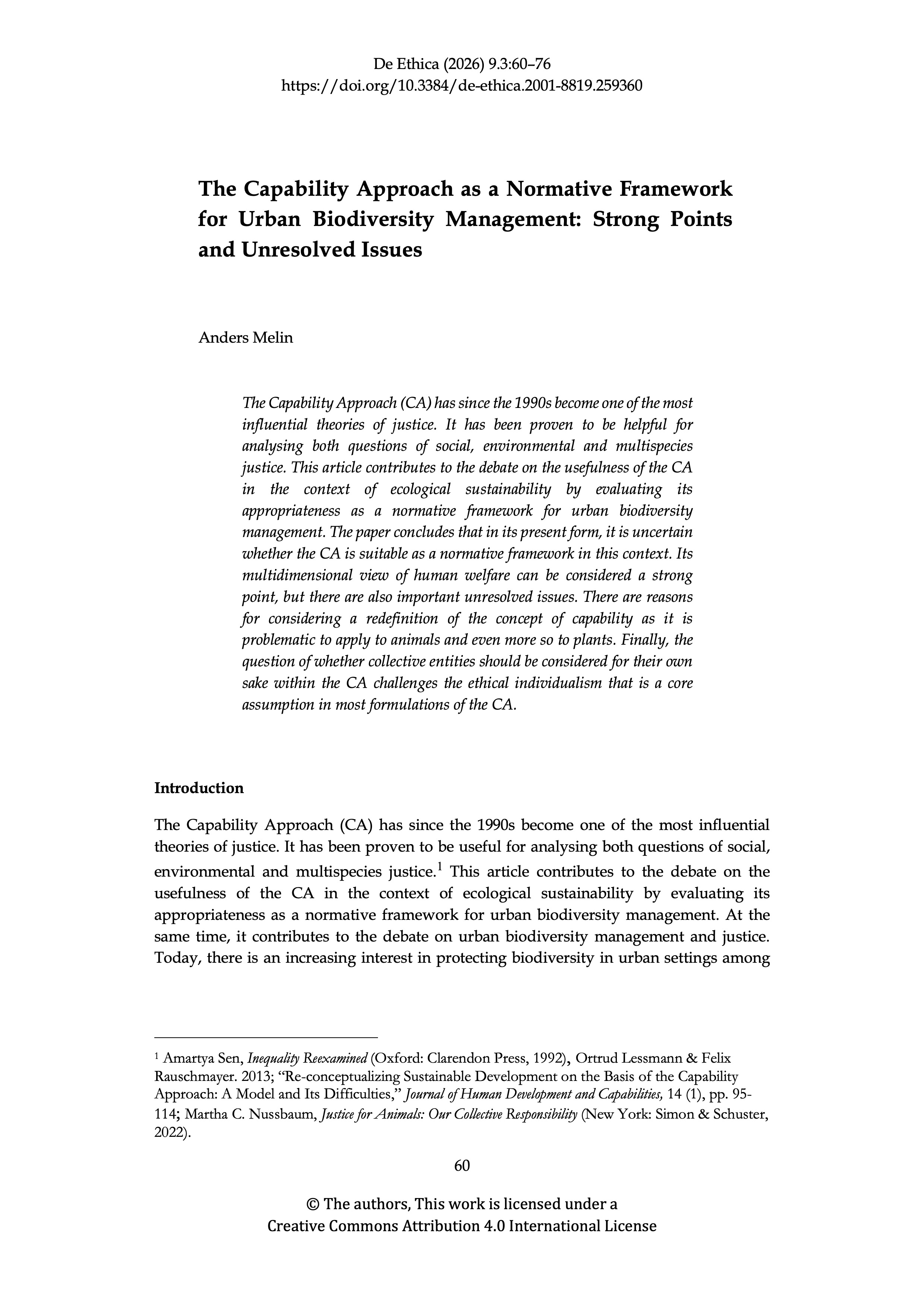
The Capability Approach (CA) has since the 1990s become one of the most influential theories of justice. It has been proven to be helpful for analysing both questions of social, environmental and multispecies justice. This article contributes to the debate on the usefulness of the CA in the context of ecological sustainability by evaluating its appropriateness as a normative framework for urban biodiversity management. The paper concludes that in its present form, it is uncertain whether the CA is suitable as a normative framework in this context. Its multidimensional view of human welfare can be considered a strong point, but there are also important unresolved issues. There are reasons for considering a redefinition of the concept of capability as it is problematic to apply to animals and even more so to plants. Finally, the question of whether collective entities should be considered for their own sake within the CA challenges the ethical individualism that is a core assumption in most formulations of the CA.
References
Adams, Clark E. Urban Wildlife Management. Boca Raton, FL: CRC Press, 2021.
Agar, Nicholas. Life’s Intrinsic Value. Science, Ethics, and Nature. New York: Columbia University Press, 2001.
Anand, Sudhir and Amartya Sen. ”Human Development and Economic Sustainability”. World Development, 28: 12 (2000), pp. 2029-2049.
Baard, Patrik. Ethics in Biodiversity Conservation (Routledge Studies in Conservation and the Environment). London: Routledge, 2021.
Basl, John. The Death of the Ethic of Life. Oxford: Oxford University Press, 2019.
Bele, Archana and Ujwala Chakradeo. “Public Perception of Biodiversity: A Literature Review of its Role in Urban Green Spaces,” Journal of Landscape Ecology, 14:2, (2021), pp. 1-28.
Bendik-Keymer, Jeremy. “Beneficial relations between species & the moral responsibility of wondering”, Environmental Politics, 31:2 (2022), pp. 320-337.
Cox, Damian, Marguerite La Caze and Michael Levine. “Integrity” in Stanford encyclopedia of philosophy, edited by Edward N. Zalta and Uri Nodelman, https://plato.stanford.edu/entries/integrity/. (Revised February 20, 2017).
Crescenzo, Daniel L. “Loose Integrity and Ecosystem Justice on Nussbaum’s Capabilities Approach,” Environmental Philosophy, 10:2 (2013), pp. 53-74.
Delon, Nicolas “Animal Capabilities and Freedom in the City,” Journal of Human Development and Capabilities, 22:1, (2021), pp. 131-153.
Dijkstra, Lewis, Aneta J. Florczyk, Sergio Freire, Thomas Kemper, Michele Melchiorri, Martino Pesaresi and Marcello Schiavina. “Applying the Degree of Urbanisation to the globe: A new harmonization reveals a different picture of global urbanization,” Journal of Urban Economics, 125 (2021), 103312.
European Environment Agency. “Biodiversity – Ecosystems,” online at https://www.eea.europa.eu/themes/biodiversity/intro (accessed 2024-06-07).
Farinha-Marques, P., J.M. Lameiras, C. Fernandes, S. Silva and F. Guilherme. ”Urban biodiversity: a review of current concepts and contributions to multidisciplinary approaches,” Innovation: The European Journal of Social Science Research, 24:3 (2011), pp. 247-272.
Frank, David M. “Biodiversity” and biological diversities. Consequences of pluralism between biology and policy,” In Routledge Handbook of Philosophy of Biodiversity, edited Justin Garson, Anya Plutynski and Sahotra Sahar. Milton Park, Abingdon, Oxfordshire: Routledge, 2016, pp. 96-109.
Fulfer, Katy. “The Capabilities Approach to Justice and the Flourishing of Nonsentient Life”. Ethics & Environment, 18:1, (2013), pp. 19-38.
Hailwood, Simon. “Bewildering Nussbaum: Capability Justice and Predation,”. The Journal of Political Philosophy, 20:3, (2012), pp. 293-313.
Hunter, Jr., Malcolm L., James P. Gibbs and Viorel D. Popescu. Fundamentals of Conservation Biology. Hoboken, NJ: Wiley Blackwell, 2021.
Inger, Richard, Daniel T. C. Cox, Esra Per, Briony A. Norton, and Kevin J. Gaston, (2016). “Ecological role of vertebrate scavengers in urban ecosystems in the UK”, Ecology and Evolution, 6 (2016), pp. 7015-7023.
Korsgaard, Christine 2018. Fellow Creatures: Our Obligations to the Other Animals. Oxford: Oxford University Press.
Lambert, Max R. and Christopher J. Schell 2023. “Cities as the Solution to the Biodiversity Crisis,” in Urban Biodiversity and Equity: Justice-centered conservation in cities, edited by Max R. Lambert and Christopher J. Schell. Oxford: Oxford University Press, 2023, pp. 1-21.
Lessmann, Ortrud and Felix Rauschmayer. “Re-conceptualizing Sustainable Development on the Basis of the Capability Approach: A Model and Its Difficulties,” Journal of Human Development and Capabilities, 14:1 (2013), pp. 95-114.
Light, Andrew. “The Urban Blind Spot in Environmental Ethics. Environmental Politics, 10:1 (2001), pp. 7-35.
Linch, Amy and Breena Holland. “Cultural Killing and Human-Animal Capability Conflict,” Journal of Human Development and Capabilities, 18:3 (2017), pp. 322-336.
Mallat, Jon, Michael R. Blatt, Andreas Draguhn, David G. Robinson, and Lincoln Taiz, ”Debunking a myth: plant consciousness”. Protoplasma, 258 (2021), pp. 459-476.
Melin, Anders. Living with Other Beings: A virtue-oriented approach to the ethics of species protection (Studies in Religion and the Environment, Vol. 9). Münster: LIT Verlag 2013.
Melin, Anders “Should we Ascribe Capabilities to Species and Ecosystems? A Critical Analysis of Ecocentric Versions of the Capabilities Approach”, Journal of Agricultural and Environmental Ethics, 34:26, 2021.
Melin, Anders, and David Kronlid. “Should We Ascribe Capabilities to Sentient Animals? A Critical Analysis of the Extension of Nussbaum’s Capabilities Approach,” De Ethica: A Journal of Philosophical, Theological and Applied Ethics, 3:2 (2016), pp. 53-63.
Michelfelder, Diane P. “Valuing Wildlife Populations in Urban Environments”, Journal of Social Philosophy, 34:1 (2023), pp. 79-90.
Millenium Ecosystem Assessment. Ecosystems and Human Well-Being: Synthesis. Washington, D.C.: IslandPress, 2005.
Newman, Jonathan A., Gary E. Varner, and Stefan Linquist. Defending Biocentrism: Environmental Science and Ethics. Cambridge: Cambridge University Press, 2017.
Nilon, Charles H. and Myla F. J. Aronson (Eds.). Routledge Handbook of Urban Biodiversity, Milton Park, Abingdon, Oxfordshire: Routledge, 2024.
Noll, Samantha. “History Lessons: What Urban Environmental Ethics Can Learn from Nineteenth Century Cities. Journal of Agricultural and Environmental Ethics, 28 (2015), pp. 143-159.
Nowak, David J., Daniel E. Crane and Jack C. Stevens. “Air pollution removal by urban trees and shrubs in the United States”, Urban forestry & urban greening, 4 (2006), pp. 115-123.
Nussbaum, Martha C. Women and Human Development. The Capabilities Approach. Cambridge: Cambridge University Press, 2000.
Nussbaum, Martha C. Frontiers of Justice: Disability, Nationality, Species Membership. Cambridge, MA: The Belknap Press of Harvard University Press, 2006.
Nussbaum, Martha C. Creating Capabilities: The Human Development Approach. Cambridge, MA: The Belknap Press of Harvard University Press, 2011.
Nussbaum, Martha C. Justice for Animals: Our Collective Responsibility. New York: Simon & Schuster, 2022.
Page, Edward A. “Intergenerational justice of what? Welfare, resources or capabilities?”, Environmental Politics, 16:3 (2007), pp. 453-469.
Palmer, Clare. “Placing Animals in Urban Environmental Ethics”, Journal of Social Philosophy, 34:1 (2003), pp. 64-78.
Qiu, Lin, Stefan Lindberg and Anders B. Nielsen. ”Is biodiversity attractive? – On-site perception of recreational and biodiversity values in urban green space,” Landscape and Urban Planning, 119 (2013), pp. 136-146.
Regan, Tom 2004 [originally published in 1983]), The Case for Animal Rights (updated with a new preface), University of California Press.
Robeyns, Ingrid. Wellbeing, Freedom and Social Justice: The Capability Approach Re-Examined. Cambridge: Open Book Publishers, 2017.
Sarkar, Sahotra. “Approaches to biodiversity,” in Routledge Handbook of Philosophy of Biodiversity, edited by Justin Garson, Anya Plutynski and Sahotra Sahar. Milton Park, Abingdon, Oxfordshire: Routledge, 2016, pp. 43-55.
Schlosberg, David. Defining Environmental Justice: Theories, Movements, and Nature. Oxford: Oxford University Press, 2007.
Schlosser, Markus. 2015. “Agency,” In, Stanford encyclopedia of philosophy, edited by Edward N. Zalta and Uri Nodelman (Eds.) online at https://plato.stanford.edu/entries/agency/. (August 10, 2015).
Segundo-Ortin, Miguel and Paco Calvo. “Consciousness and cognition in plants,” WIREs Cognitive Science, (2021). 13e1578.
Sen, Amartya. Equality of what? online at http:// tannerlectures.utah.edu/ _documents/a-to-z/s/sen 80.pdf, 1979.
Sen, Amartya. Inequality Reexamined. Oxford: Clarendon Press, 1992.
Sen, Amartya. The Idea of Justice. London: Allen Lane, 2009.
Singer, Peter. Practical Ethics. Cambridge: Cambridge University Press, 2011.
UN (1992). Convention on Biological Diversity.
Varner, G. E. (1998). In Nature’s Interests? Interests, Animals Rights, and Environmental Ethics. New York: Oxford University Press.
Varner, Gary E. Personhood, Ethics, and Animal Cognition: Situating Animals in Hare’s Two Level Utilitarianism. Oxford: Oxford Scholarship Online, 2012.
Wienhues, Anna. Ecological Justice and the Extinction Crisis: Giving Living Beings their Due. Bristol: Bristol University Press, 2020.
Wolch, Jennifer R., Jason Byrne and Joshua P. Newell. “Urban green space, public health, and environmental justice: The challenge of making cities ‘just green enough’,” Landscape and Urban Planning, 125 (2014), pp. 234-244.
Wood, Emma, Alice Harsant, Martin Dallimer, Anna Cronin de Chavez, Rosemary R. C. McEachan and Christopher Hassall. “Not All Green Space Is Created Equal: Biodiversity Predicts Psychological Restorative Benefits From Urban Green Space,” Frontiers in Psychology, 9 (2018), article 2320.
Downloads
Published
How to Cite
Issue
Section
License
Copyright (c) 2026 Anders Melin

This work is licensed under a Creative Commons Attribution 4.0 International License.